Tile and grout are not waterproof. That single fact is the most misunderstood thing about a shower. What keeps water out of your framing and out of the room below is a waterproofing system installed behind and beneath the tile — and it is completely invisible once the shower is finished. It is also the one part of a bathroom where cutting corners does the most expensive damage.
A quality shower is built to a real standard. The tile industry's ANSI A118.10 standard defines what a load-bearing, bonded waterproofing membrane has to do, and reputable installers build to it. This guide explains the main systems, how the base and drain fit in, and the exact spots where showers leak — so you know what to ask any Kansas City contractor before you sign.
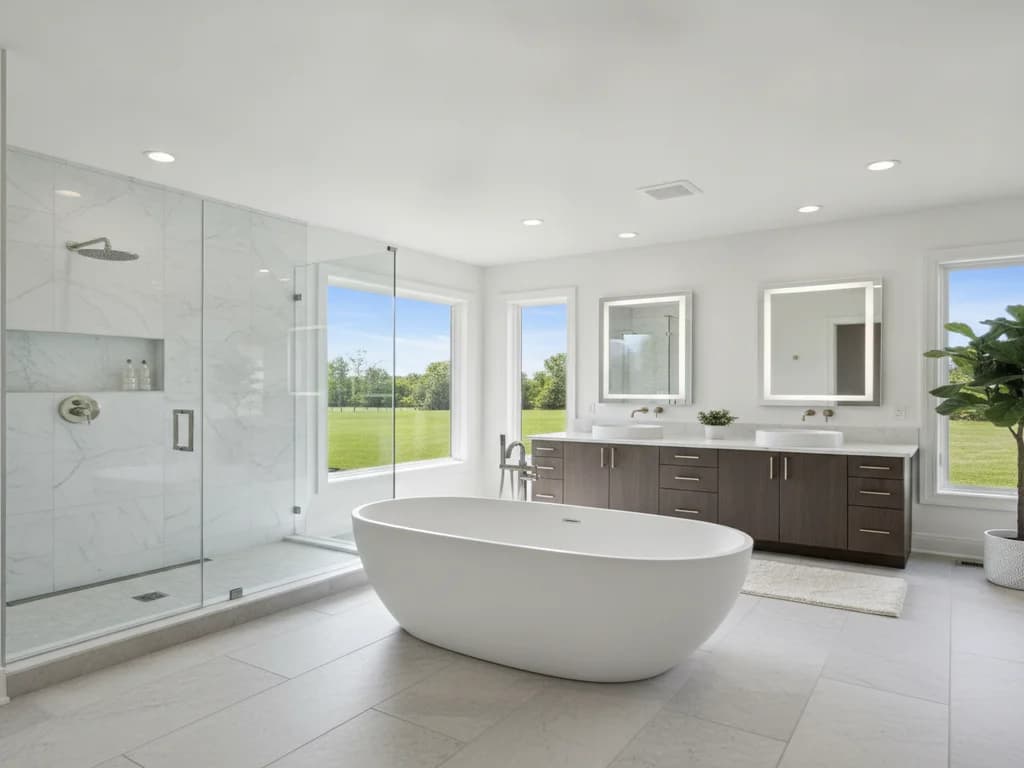
Almost every quality shower is waterproofed with one of these three approaches. Any of them can last for decades when installed correctly to the manufacturer's specification.
A waterproof sheet membrane is bonded to the walls and floor with thinset, with seams and corners sealed with matching banding. Foam or backer board goes up first, then the membrane creates one continuous, tile-ready waterproof surface from the drain to full height. It is a clean, reliable, widely used modern approach and integrates neatly with foam shower pans and niches.
A liquid membrane is rolled or troweled onto the backer board in coats, with fabric or banding reinforcing the corners and changes of plane. Done to the manufacturer's required thickness (and it must reach that thickness to perform), it forms a seamless waterproof layer. It is flexible around odd shapes but depends heavily on careful, even application.
The older, proven method: a sloped mortar bed over a PVC or CPE pan liner that drains through a clamping (two-part) drain. It has waterproofed showers for decades and still works well in skilled hands, though it is more labor-intensive and slower to build than modern bonded systems.
The base is where most of the engineering happens. Water has to slope to the drain from every point, so the pan is built to fall evenly — either a pre-sloped foam pan or a hand-packed mortar bed.
The drain has to match the system. Modern bonded membranes use a bonding-flange drain; traditional liners use a two-part clamping drain that seals the liner. For a curbless shower, a linear drain along one wall lets the whole floor slope in a single direction, which keeps water in the shower without a curb to step over.
Every change of plane — inside corners, the curb, the bench, the niche — is a potential leak and gets reinforced and sealed. This is where an experienced installer earns their keep.
Showers almost never leak through the middle of a flat, well-built wall. They fail at the details — and every failure below is avoidable with correct waterproofing.
Relying on tile and grout to hold water
The most common failure of all: no dedicated membrane, just tile over ordinary backer or, worse, over drywall. Grout is not waterproof and will let moisture through over time. Water then sits in the framing until rot, mold, or a stain on the ceiling below finally shows it.
Unsealed corners, niches, and benches
Flat walls rarely leak; the joints do. Inside corners, the curb, a recessed niche, and a bench are all changes of plane that must be banded or reinforced. Skip that step and the membrane has a gap exactly where water collects.
A base that does not slope correctly
If the pan does not fall evenly to the drain, water pools and finds the weakest point. A flat or reverse-sloped spot behind the tile is a slow leak waiting to happen, and it is invisible until damage appears.
Mixing incompatible parts
A bonded membrane needs its matching drain; a liner needs a clamping drain. Combining pieces from systems that were never designed to work together breaks the waterproof chain at the most critical point — the drain.
Kansas City's humid summers push a lot of moisture into a bathroom, and a shower that leaks behind the tile has that moisture working on the framing year-round. Proper waterproofing is what lets the visible finishes last, which is why we never treat it as the place to save money.
Our older housing stock raises the stakes. When we open a wall in a pre-war or mid-century KCMO, Independence, or inner-Kansas-side bathroom, we regularly find soft subfloor or rotted framing from a shower that was never truly waterproofed. We show you whatever we find, repair it, and rebuild on a sound structure — with a membrane system built to ANSI A118.10 — so the new shower is not sitting over the last one's mistake.
Waterproofing is also only half of moisture control. The EPA is clear that controlling mold means controlling moisture and keeping indoor humidity between 30% and 50%, so we pair the membrane with a properly sized, exterior-vented exhaust fan on every shower we build.