A deck looks simple — a platform and some railing — but it is a structure that has to carry people, furniture, and snow load, resist decades of weather, and stay firmly attached to your house without letting water in. In the Kansas City metro, a deck also has to deal with expansive clay soils that heave and shrink, a real winter frost depth that dictates how deep footings must go, and humid summers that punish the wrong materials. What you spend, and what you get, is decided far more by the structure below the boards than by the boards themselves.
This guide explains what genuinely drives deck cost across the KC metro — from ground-level platforms in Olathe and Lee's Summit backyards to elevated, multi-level decks on the sloped lots common around the metro. We will not quote a dollar figure for your deck, because an honest number depends on your size, height, material, and site conditions. What we will do is help you choose materials wisely and plan a budget that accounts for the parts you cannot see.
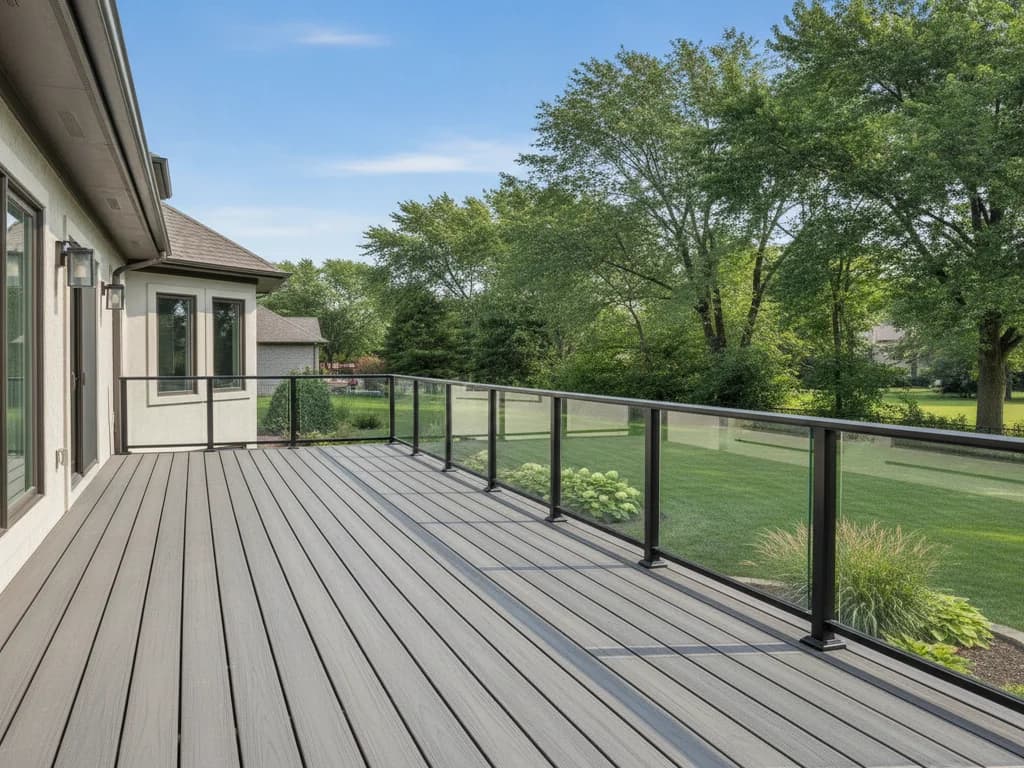
Your decking and railing material shapes both the up-front price and years of maintenance. Here is how the main options compare for Kansas City yards.
Pressure-treated wood
Lowest up-front cost, most maintenance
Pressure-treated pine is the most budget-friendly decking and framing material and remains the workhorse of the market. It costs the least to build but demands the most upkeep — cleaning, sealing, and staining every few years — and it moves, checks, and weathers over time in the metro's humidity and temperature swings.
Cedar and premium wood
Natural beauty, moderate upkeep
Cedar and other premium woods offer natural rot resistance and a warm look that many homeowners love. They cost more than pressure-treated and still need periodic sealing to hold their color and resist the elements, but they age gracefully when maintained.
Composite and capped decking
Premium boards, low maintenance
Composite and capped-polymer decking (for example, Trex or TimberTech) costs more up front but eliminates sanding, sealing, and staining, resists fading and moisture, and holds up well to Kansas City summers. Most of the added cost is in the decking surface and railing; the framing beneath is still typically pressure-treated lumber.
Railing, stairs, and framing
Where a lot of the budget actually lives
Railing style (wood, composite, metal balusters, cable, or glass), the number and length of stairs, and the framing and hardware all carry real cost. On many decks the railing and stairs are a larger share of the budget than homeowners expect, and taller decks multiply both.
Pressure-treated wood is typically the least expensive way to build a deck up front, cedar sits in the middle, and composite is the premium tier. But the honest comparison is over time: composite costs more to install and far less to maintain, while pressure-treated costs less to install and more to keep up. The right choice depends on how long you plan to keep the home and how much upkeep you want to do.
Every deck budget is a mix of the same factors. Understanding their relative weight tells you where the money really goes — and it is not all in the boards you walk on.
Square footage sets the baseline, but height is the hidden multiplier. An elevated deck needs taller posts, more substantial footings, longer stairs, and often guardrails all around — all of which add material and labor well beyond what the extra square footage alone suggests.
The jump from pressure-treated to cedar to composite is the biggest lever you control on the visible surfaces, and railing style stacks on top of it. Composite boards with a matching composite or metal rail system cost substantially more than a stained wood deck of the same size.
Footings must reach below the local frost line and be sized for the load and the soil. On Kansas City's clay soils, proper footing depth and sizing are not optional — they are what keep the deck from heaving and settling. Difficult access or hard digging adds labor.
Where a deck attaches to the house, the ledger board and its flashing are safety- and moisture-critical. Done wrong, this connection is the leading cause of deck collapses and of water damage into the wall. Correct hardware and flashing here are worth every dollar.
Stairs are labor-intensive, and features like built-in benches, lighting, pergolas, multiple levels, or a covered roof each add meaningful cost. A simple rectangular deck is far cheaper per square foot than a multi-level deck with stairs and built-ins.
A deck is only as good as what it stands on, and Kansas City yards bring specific challenges. These site conditions shape how much foundation work your deck needs and are a major reason two similar-looking decks can cost differently.
Expansive clay soils
Much of the Kansas City area sits on clay soils that swell when wet and shrink when dry. That movement can heave inadequate footings and rack a deck over time. Properly sized and placed footings are the defense, and soil conditions can affect how much foundation work a given yard needs.
Frost-depth footings
Kansas City has a real winter, and footings must extend below the local frost line so they do not lift when the ground freezes and thaws. This is set by local code and is one reason a deck's foundation is more involved — and more important — than it looks.
Sloped and walkout lots
Many metro lots, especially those with walkout basements, slope away from the house. That often means an elevated deck with taller posts, longer stairs, and full guardrails — a bigger structure than a flat-yard, ground-level platform.
Drainage and grading
How water moves across your yard affects both the deck footings and what you can do with the space beneath an elevated deck. Poor drainage near footings is worth addressing during the build rather than fighting later.
Replacing an aging deck
If you are replacing an old deck, demolition and disposal are part of the cost, and the old footings and ledger attachment often do not meet current code — so a replacement is frequently a full rebuild rather than a resurfacing.
Most decks require a permit, and attached or elevated decks almost always do — for good reason. Deck codes govern footing depth, ledger attachment, guardrail height, and stair dimensions precisely because these are the elements that fail dangerously when built wrong. The permitting authority depends on your city — Kansas City, Missouri, the Unified Government of Wyandotte County, or a Johnson County municipality such as Overland Park or Olathe — and some HOAs review deck designs as well. We pull the permit, build to code, and schedule inspections as part of the project.
Decks are built across much of the year in the metro, with spring through fall offering the most reliable weather for digging footings and framing. Spring is peak demand as homeowners rush to be ready for summer, so lead times run long; planning a build for late summer or fall often means more scheduling flexibility. Deep-winter frozen ground can complicate footing work, which is another reason to plan ahead rather than scramble in April.
A dependable deck budget comes from a clear process. Here is the approach we walk Kansas City homeowners through before the first footing is dug.
Define size, height, and how you will use it
Start with footprint and height, and be honest about use — dining, lounging, a hot tub, multiple levels. Height and features drive cost far more than square footage alone, so nail these down first.
Choose your decking and railing material
Decide between pressure-treated wood, cedar, and composite, and pick a railing style. Weigh up-front cost against years of maintenance; composite costs more now and less later, wood the reverse.
Budget for the structure you cannot see
Footings sized for KC clay and set below frost depth, a correctly flashed ledger, and proper hardware are where safety and longevity live. Never let these be the line items a bid trims to look cheaper.
Account for demolition and site work
If an old deck is coming out, or the lot slopes or drains poorly, include demolition, disposal, and any grading. These are common on metro lots and easy to forget in a first pass.
Get a fixed-price, line-item proposal
Insist on a written scope with a fixed price broken out by line item — footings, framing, decking, railing, stairs, and features. That is how we quote every Kansas City deck, tied to your actual yard and design rather than a per-square-foot average.
For a broad frame of reference, national industry surveys such as Remodeling magazine's annual Cost vs. Value report track typical deck-addition ranges and resale return by region. Use them as a sanity check, not a quote — the only number that matters for your home is the fixed-price proposal we prepare after seeing your yard and design.
A cheap deck bid often wins by trimming footings, hardware, or the ledger detail — exactly the parts that keep the deck safe. Compare on the structure, not just the surface.
- Confirm footing depth and size are specified to local frost depth and your soil — vague footing details are a safety and longevity red flag.
- Check that the ledger attachment and flashing method are spelled out; this connection is the most common point of deck failure.
- Compare the exact decking and railing products, since pressure-treated, cedar, and composite are not interchangeable on price.
- Make sure demolition, disposal, and any grading are in the scope if you are replacing an old deck.
- Verify the deck will be permitted and inspected, and that the builder pulls the permit rather than leaving it to you.
- Confirm licensing, insurance, and a written workmanship warranty in addition to any decking-material warranty.
A deck is an investment in how you use your home, and financing options are available for homeowners who prefer to spread the cost across the seasons they will enjoy it. The best first step is a fixed-price proposal, so any financing conversation is grounded in a real number for your yard and design rather than a rough per-square-foot guess.