The glass is the last decision in most shower projects, and it changes the look of the whole room. There are three real options: fully frameless, semi-frameless, and framed. They differ in price, in how much cleaning they ask of you, and — importantly in Kansas City's older homes — in how forgiving they are of walls that are not perfectly plumb.
In plain terms: frameless is the premium, minimal, easy-to-clean choice; framed is the budget-friendly, forgiving workhorse; semi-frameless splits the difference. Here is how to pick.
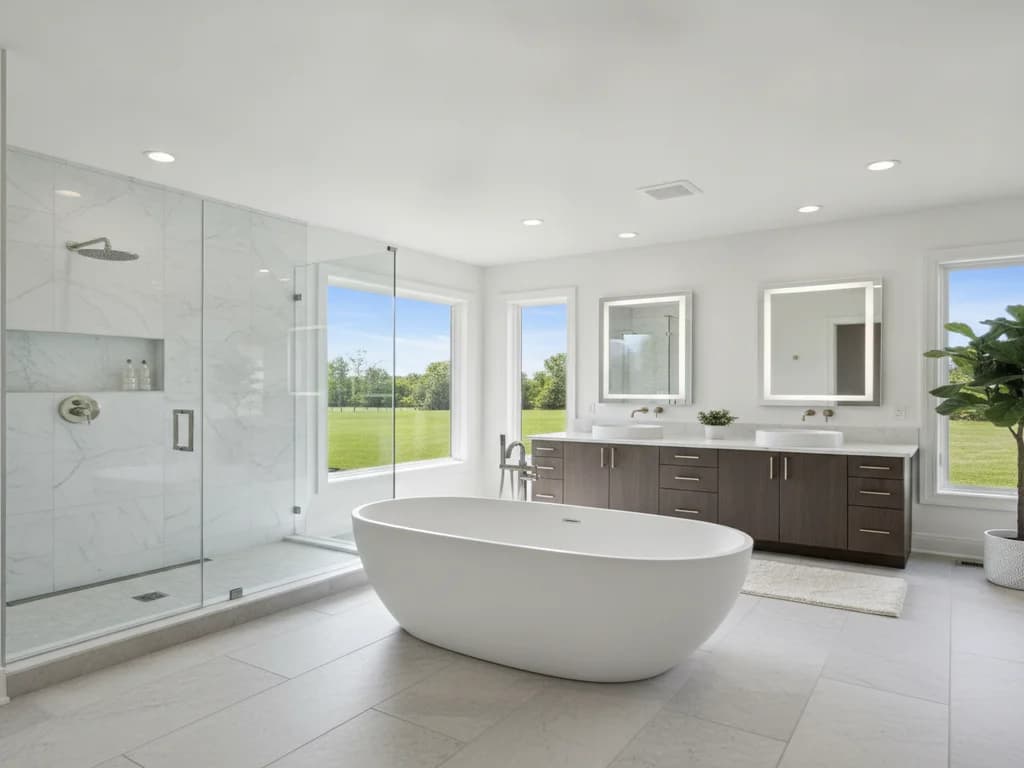
Advantages
- The modern, high-end, minimal look — nothing interrupts the view of your tile.
- Fewer metal channels means fewer places for water, soap scum, and mildew to hide.
- Makes a bathroom feel larger and more open, especially in a small room.
- Thick tempered glass and quality hardware read as a lasting, premium upgrade.
Trade-offs
- The most expensive option — heavy tempered glass and custom hardware.
- Needs precise measurement and solid wall backing, so it is not a quick swap.
- Less forgiving of out-of-plumb walls common in older homes.
- Usually made-to-measure, which adds lead time to the project.
Advantages
- The most budget-friendly enclosure, framed fully in metal.
- The frame adds structural support and hides small wall variances.
- More forgiving of the out-of-plumb walls found in older KC homes.
- Thinner glass and standard sizes keep cost and lead time down.
Trade-offs
- Metal channels collect water, soap scum, and mildew and need regular cleaning.
- The visible frame reads as more dated and interrupts the tile view.
- Semi-frameless is a middle path: a light frame at the edges, open elsewhere.
- Fewer of the seamless, custom looks a frameless panel can achieve.
Balance look, cleaning, and budget against the reality of your walls. Newer, plumb walls open the door to frameless; older, out-of-plumb walls often steer toward semi-frameless or framed.
Choose frameless if
- You want the highest-end, most modern look and the easiest glass to clean.
- Your walls are true, or we are tiling new, plumb walls anyway.
- The budget has room for thick tempered glass and custom hardware.
- You are showcasing a feature tile wall you do not want a frame to cut across.
Choose framed or semi-frameless if
- Controlling cost is a priority for this project.
- Your older home has walls that are slightly out of plumb.
- You want a practical, well-supported enclosure for a busy family bath.
- Semi-frameless gives you a cleaner look than framed without the frameless price.
Two Kansas City realities push this decision. First, hard water. Our mineral-heavy water spots glass and builds scale in any metal channel, so framed enclosures ask for more cleaning at the frame while frameless glass has far less hardware to trap it. A squeegee habit helps every type, but frameless is genuinely lower-maintenance here.
Second, older walls. Much of the metro's charm is in pre-war and mid-century homes, and their walls are often slightly out of plumb. A fully frameless panel wants true, solid walls; a framed or semi-frameless unit hides small variances behind its channel. When we tile a shower new, we build the walls plumb and frameless becomes an easy option — but on a lighter remodel of an older bath, framed or semi-frameless is often the smarter, cleaner-looking result.
Whatever the glass, moisture control is about the fan, not the enclosure. We size ventilation to the room and vent it outside so the room dries between uses — the enclosure only decides how the shower looks and cleans, not whether the bathroom stays healthy.